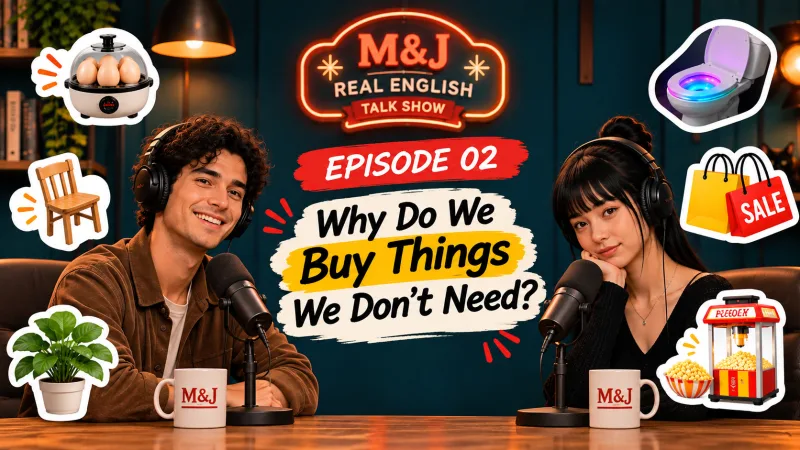


Hi, I'm June — welcome back to M&J Real English Talk Show!
Episode 02 is here: Why Do We Buy Things We Don't Need?
Mike got a mystery package — and he doesn't remember what he bought. Inside: a little egg-cooking machine. June shares her own shopping secret, Mike buys the wrong chair, and together they try a seven-day challenge to stop buying things on impulse.
Level A2+, for listening practice and everyday expressions about shopping, money, returns, and changing your mind.
CHAPTERS
0:00 Intro music
0:08 Part 1 — THE MYSTERY PACKAGE
5:18 Part 2 — THE SALE
10:46 Part 3 — JUNE'S SHOPPING SECRET
17:37 Part 4 — THE WRONG CHAIR
23:00 Part 5 — THE SEVEN-DAY CHALLENGE
27:49 Part 6 — REAL ENGLISH AND ONE LAST SURPRISE
USEFUL EXPRESSIONS
on sale
a good deal
check the size
return something
return shipping
worth it
change my mind
I couldn't help it
What a waste!
QUESTION OF THE DAY
What's the strangest thing you've ever bought? Tell us in the comments!
FULL TRANSCRIPT
Transcript from the episode's subtitle file, supplied by the user. Speaker labels as in the file.
June: Hey, everyone! Welcome back to M&J Real English Talk Show! I'm June.
Mike: And I'm Mike. June, I need your help.
June: Oh, no. What happened this time?
Mike: Why do you always say that?
June: Because every time you need help, there's a story.
Mike: Well, this time it's a shopping story.
June: Okay. What did you buy?
Mike: That's the problem. I don't remember.
June: You don't remember what you bought?
Mike: No. A package came yesterday, and I had no idea what was inside.
June: Maybe somebody sent you a gift.
Mike: That's what I thought!
June: So you opened it?
Mike: Of course. I was very excited.
June: What was inside?
Mike: A little machine that cooks eggs.
June: An egg machine?
Mike: Yes. You put eggs inside, add some water, and wait. Then you have breakfast.
June: Okay. That sounds useful.
Mike: Thank you!
June: But Mike, don't you already have a stove?
Mike: Yes.
June: And a pan?
Mike: Yes.
June: And you know how to cook eggs?
Mike: Yes.
June: So why did you buy a machine to do the same thing?
Mike: Because it was on sale.
June: Of course it was.
Mike: Fifty percent off!
June: How much did you pay?
Mike: Forty dollars.
June: Forty dollars?
Mike: Yes. It was eighty dollars before.
June: So you spent forty dollars.
Mike: No, June. I saved forty dollars.
June: Mike, you didn't save forty dollars!
Mike: The website said I did.
June: But you didn't need the machine!
Mike: Okay, let me explain.
June: I'm listening.
Mike: It was eighty dollars. I only paid forty. That's a good deal.
June: But if you didn't buy it, you would still have your forty dollars.
Mike: That's true.
June: So?
Mike: I think I need another cup of coffee.
June: You always need coffee when you don't have an answer.
Mike: Coffee helps me think.
June: Then maybe you should drink coffee before shopping.
Mike: That's actually a good idea.
June: So, have you tried the egg machine?
Mike: Not yet.
June: Why not?
Mike: I haven't had time.
June: When did you buy it?
Mike: Three weeks ago.
June: Three weeks!
Mike: I forgot about it!
June: Mike, you bought something you didn't need, forgot about it, and haven't used it.
Mike: Yeah. When you put it that way, it sounds bad.
June: Because it is bad!
Mike: Okay, okay.
June: What made you want it in the first place?
Mike: I saw a video online.
June: What kind of video?
Mike: A man was making breakfast. He used the machine, and his eggs came out perfect.
June: And that made you want one?
Mike: Yes. He looked so happy.
June: Maybe he was just happy because he was eating breakfast.
Mike: Maybe. But his kitchen looked great too.
June: Mike, buying an egg machine won't give you a new kitchen.
Mike: I know that now.
June: So what are you going to do with it?
Mike: I might try it this weekend.
June: Good.
Mike: Or I might return it.
June: Even better.
Mike: But there's one problem.
June: What?
Mike: I threw away the box.
June: Oh, no. Can you still return it?
Mike: Probably not. I should have kept the box.
June: Well, maybe you should finally try making some eggs.
Mike: I guess so.
June: Why did you throw away the box before trying the machine?
Mike: My kitchen was getting full of boxes.
June: Full of boxes?
Mike: Yeah. I get a lot of packages.
June: I think I'm starting to understand your problem.
Mike: Really? Because I don't.
June: Well, that's what we're talking about today. Why do we buy things we don't need?
Mike: I think I know the answer.
June: What's that?
Mike: Because shopping is fun.
June: And paying for it?
Mike: That part is less fun.
June: Let's talk about sales. Why do you like them so much?
Mike: Because I like getting a good price.
June: Everyone likes a good price.
Mike: Exactly.
June: But a good price doesn't always mean you should buy something.
Mike: Okay. Give me an example.
June: Let's say you're in a store. You see a black jacket.
Mike: I like black jackets.
June: I know. The jacket is fifty dollars.
Mike: Okay.
June: It was one hundred dollars before.
Mike: Wow. Fifty percent off!
June: Right. But you already have two black jackets at home.
Mike: Hmm. What does this one look like?
June: Mike, that's not important.
Mike: It might be important.
June: Fine. It's a normal black jacket.
Mike: Is it comfortable?
June: Yes.
Mike: Does it have pockets?
June: Yes!
Mike: Big pockets?
June: Mike!
Mike: I'm just asking!
June: You don't need another jacket.
Mike: Okay. That's true.
June: So if you buy it, how much money do you spend?
Mike: Fifty dollars.
June: And if you don't buy it?
Mike: Nothing.
June: Exactly. You keep your fifty dollars.
Mike: Hmm. That's a good point.
June: So a sale is only a good deal if you really want or need the thing.
Mike: I think I understand.
June: Good.
Mike: But what if the jacket is seventy percent off?
June: Mike!
Mike: Okay, okay! I'm learning.
June: Slowly.
Mike: Very slowly.
June: Have you ever walked into a store to buy one thing and come home with five things?
Mike: All the time.
June: Me too, actually.
Mike: Really?
June: Yes. Last week I went to buy toothpaste.
Mike: That's normal.
June: I came home with toothpaste, two candles, some chocolate, and a new coffee cup.
Mike: June! You went to buy toothpaste!
June: I know.
Mike: Why did you buy the candles?
June: They smelled really nice.
Mike: And the chocolate?
June: I was hungry.
Mike: And the coffee cup?
June: It was beautiful.
Mike: Did you need a new cup?
June: Not really.
Mike: Aha!
June: Don't start.
Mike: I'm just happy I'm not the only one.
June: I think stores make it very easy to buy more than we planned.
Mike: That's true. You walk in for toothpaste, and suddenly you're looking at coffee cups.
June: Exactly.
Mike: What color was your cup?
June: Green.
Mike: Nice.
June: With little white flowers.
Mike: That does sound nice.
June: See?
Mike: How much was it?
June: Six dollars.
Mike: Not bad.
June: And it makes me happy every morning.
Mike: Then maybe it was worth it.
June: Maybe. I use it every day.
Mike: So here's a question. Is it okay to buy something just because it makes you happy?
June: I think so, sometimes. If you have enough money, and you really enjoy it, why not?
Mike: Good. Because I have something else I want to tell you.
June: Oh, no.
Mike: I bought a little light for my bathroom.
June: Okay?
Mike: It goes inside the toilet.
June: Inside the toilet?
Mike: Yes.
June: Why?
Mike: It lights up at night.
June: So you can see where the toilet is?
Mike: Exactly!
June: Mike, your bathroom is not that big.
Mike: I know!
June: You already know where the toilet is!
Mike: But this light changes colors.
June: How many colors?
Mike: Seven.
June: Seven?
Mike: Yeah. Red, blue, green
June: Okay, okay. I get it.
Mike: It looks really cool.
June: Do you use it?
Mike: Well, I don't really need it. I mostly just look at the colors.
June: You bought a light so you could look at your toilet?
Mike: Yes.
June: How much did it cost?
Mike: Twelve dollars.
June: And you're happy with it?
Mike: Very happy.
June: Okay, Mike. You can keep your toilet light.
Mike: Thank you.
June: But maybe you don't need to buy another one.
Mike: Another one?
June: Yes.
Mike: What if I have two bathrooms?
June: MIKE!
Mike: Okay, June. We've talked enough about my shopping.
June: Have we?
Mike: Yes. Now I want to hear about something you bought that you didn't need.
June: Hmm. Well, I have a story.
Mike: Good. I'm ready.
June: Last year, I wanted to make my living room look nicer.
Mike: Okay.
June: I saw some beautiful pictures online. There were plants everywhere. Big green plants, little plants, flowers by the windows.
Mike: Sounds nice.
June: So I thought, "I want some plants in my house."
Mike: Good idea.
June: I went to a store and bought five plants.
Mike: Five?
June: Yes.
Mike: That's a lot for one day.
June: They weren't very big.
Mike: Okay.
June: I took them home and put them in different places. One on the table, two near the window, and two on a shelf.
Mike: And did they look good?
June: Beautiful. My living room looked so nice.
Mike: Great!
June: For about two weeks.
Mike: Uh-oh.
June: One morning, I saw that one plant had brown leaves.
Mike: That's not good.
June: I thought it needed water. So I gave it water.
Mike: Okay.
June: The next day, it looked worse.
Mike: Oh, no.
June: So I gave it more water.
Mike: More water?
June: Yes.
Mike: Did that help?
June: No. A few days later, the plant died.
Mike: Oh, that's sad.
June: I know. Then another plant started looking bad.
Mike: What did you do?
June: I gave it water.
Mike: June.
June: What?
Mike: Didn't the first plant die after you gave it more water?
June: Yes, but I didn't understand that was the problem.
Mike: Oh, okay.
June: After a few weeks, three of my five plants were dead.
Mike: Three?
June: Yes.
Mike: That's terrible.
June: I felt really bad. I wanted to take better care of the other two.
Mike: So what did you do?
June: I started watching videos about plants.
Mike: Like me watching shopping videos?
June: A little.
Mike: And?
June: I learned that some plants don't need much water.
Mike: Right.
June: Then I saw a special light online. It was made to help plants grow inside.
Mike: Did you buy it?
June: Yes.
Mike: How much?
June: Sixty dollars.
Mike: Sixty dollars?
June: Yes.
Mike: For a light?
June: For my plants!
Mike: How many plants did you have left?
June: Two.
Mike: Okay. Go on.
June: I also bought some new plant pots.
Mike: How many?
June: Six.
Mike: Six pots for two plants?
June: They were on sale!
Mike: June! You said it!
June: What?
Mike: "On sale!" That's exactly what I say!
June: Okay, okay!
Mike: This is wonderful.
June: Please don't get too happy.
Mike: Sorry. Please continue.
June: Then I bought a little book about plants.
Mike: Of course.
June: And a small shelf for them.
Mike: A new shelf?
June: Yes.
Mike: Wow. Your plants got a new home, a new light, and six new pots.
June: I know.
Mike: Did they get a TV too?
June: No!
Mike: Just checking.
June: So I put everything together. I moved the plants to the new shelf. I turned on the special light.
Mike: And did they get better?
June: One did.
Mike: What about the other one?
June: It died.
Mike: Oh, no.
June: I know.
Mike: So after all that, you had one plant left?
June: Yes.
Mike: Was it at least a happy plant?
June: Actually, yes. It started growing again.
Mike: Good!
June: And then one day, I moved it next to the window because I wanted to clean the shelf.
Mike: Okay.
June: A few days later, I noticed something.
Mike: What?
June: The plant looked even better.
Mike: Really?
June: Yes. It loved the sunlight from the window.
Mike: So you didn't need the special light?
June: No.
Mike: And you paid sixty dollars for it?
June: Yes.
Mike: June, your plant was asking for a window!
June: I KNOW!
Mike: Not a sixty-dollar light!
June: I know, Mike!
Mike: I'm sorry. This is too funny.
June: Well, at least I learned something.
Mike: What's that?
June: Before buying something to fix a problem, make sure you understand the problem.
Mike: That's actually a very good lesson.
June: Thank you.
Mike: And maybe don't buy six pots for two plants.
June: Okay. That too.
Mike: So where's the last plant now?
June: On my kitchen table, near the window.
Mike: Is it doing well?
June: Very well. It has new leaves.
Mike: That's great.
June: And now I know how much water it needs.
Mike: So you're a better plant owner now.
June: I think so.
Mike: Good. Because I have a question.
June: What?
Mike: Do you still have that special light?
June: Yes.
Mike: Could I borrow it?
June: Why?
Mike: I was thinking about getting a plant.
June: Mike, do you know how to take care of plants?
Mike: No. But I know someone with a very expensive plant light.
June: Oh, no. I'm not doing this again!
June: All right, Mike. Tell me about your worst online shopping mistake.
Mike: Oh, that's easy.
June: Really?
Mike: Yes. The chair.
June: What chair?
Mike: Last year, I needed a new chair for my desk.
June: Okay. That sounds normal.
Mike: My old chair was uncomfortable. So I went online and started looking.
June: Did you find one?
Mike: I did. A beautiful black chair.
June: Was it expensive?
Mike: No. It was only ten dollars.
June: Ten dollars for a desk chair?
Mike: I know! I couldn't believe the price.
June: That sounds a little strange.
Mike: I thought it was a great deal.
June: What did the pictures look like?
Mike: Great. The chair had a nice back, four legs, and a comfortable seat.
June: Okay.
Mike: So I ordered it.
June: And what happened?
Mike: Five days later, a package arrived.
June: Good.
Mike: But the box was very small.
June: How small?
Mike: About the size of a shoe box.
June: That's small for a chair.
Mike: That's what I thought.
June: Did you think the chair was in many pieces?
Mike: Exactly!
June: Okay. So you opened the box.
Mike: Yes. And inside was a chair.
June: A real chair?
Mike: A very small chair.
June: How small?
Mike: About fifteen centimeters tall.
June: Fifteen centimeters?
Mike: Yes.
June: Mike! That's tiny!
Mike: I know.
June: You bought a toy chair?
Mike: Yes.
June: How?
Mike: I didn't check the size.
June: Oh, Mike.
Mike: The pictures didn't show anything next to the chair. I thought it was big.
June: Didn't the website tell you the size?
Mike: It did.
June: And you didn't read it?
Mike: No.
June: What did you do when you opened the box?
Mike: I sat on the floor and looked at it.
June: For how long?
Mike: Maybe five minutes.
June: Why?
Mike: I was trying to understand what had happened.
June: And then?
Mike: I started laughing.
June: I think I would too.
Mike: It was a very nice little chair. Just not for me.
June: Maybe for a doll.
Mike: Yes. Or a small toy.
June: So did you return it?
Mike: I tried.
June: What happened?
Mike: I opened the website and clicked "Return."
June: Okay.
Mike: The website asked why I wanted to return it.
June: What did you write?
Mike: "Too small."
June: That's true!
Mike: Then it asked if the chair was different from the picture.
June: Was it?
Mike: No. It looked exactly like the picture.
June: Just smaller than you thought.
Mike: Right.
June: So what happened next?
Mike: They said I could send it back, but I had to pay twelve dollars for return shipping.
June: Return shipping?
Mike: Yeah. The money you pay to send something back to the store.
June: Okay. Twelve dollars?
Mike: Yes.
June: But the chair only cost ten dollars!
Mike: Exactly.
June: So it cost more to send it back than to keep it?
Mike: Yes.
June: What did you do?
Mike: I kept it.
June: Where is it now?
Mike: On my desk.
June: You keep a tiny chair on your desk?
Mike: Yes.
June: Why?
Mike: I put my phone on it.
June: Your phone?
Mike: Yeah. It's a perfect chair for my phone.
June: That's actually pretty funny.
Mike: My phone sits there while I work.
June: So your phone has its own chair.
Mike: That's right.
June: And what about you?
Mike: I bought a real chair later.
June: Did you check the size?
Mike: Three times!
June: Good.
Mike: And this time it cost more than ten dollars.
June: That's probably a good thing.
Mike: You know what I learned?
June: Always check the size?
Mike: Yes. And read the product information before buying.
June: That's very important.
Mike: Pictures can make things look different.
June: Exactly. It's also good to read reviews.
Mike: I do that now.
June: Good.
Mike: But I still have one problem.
June: What's that?
Mike: Every time I look at my phone sitting on that little chair, I start laughing.
June: Maybe the ten dollars was worth it after all.
Mike: That's what I keep telling myself.
June: So, Mike, I think we both have a shopping problem.
Mike: A little one.
June: You buy machines you don't need.
Mike: True.
June: And I buy things for plants that don't need them.
Mike: Also true.
June: Maybe we should try something different.
Mike: What do you have in mind?
June: Seven days without buying things we don't need.
Mike: Seven days?
June: Yes. One week.
Mike: That's a long time.
June: Mike, it's one week!
Mike: I know. But online stores are open every day.
June: You don't have to visit them.
Mike: That's going to be hard.
June: Let's make some simple rules.
Mike: Okay.
June: We can buy things we need. Food, soap, toothpaste, things like that.
Mike: Coffee?
June: Yes, coffee.
Mike: Good. I was getting worried.
June: But no buying things just because they're on sale.
Mike: Okay.
June: No new clothes unless we really need them.
Mike: Fine.
June: No new coffee cups.
Mike: That's for you.
June: I know.
Mike: And no more egg machines.
June: That's for you.
Mike: Fair enough.
June: Here's another idea. If you see something you want, write it down.
Mike: On a list?
June: Yes. But don't buy it right away.
Mike: How long should I wait?
June: Three days.
Mike: Three days?
June: Yes. After three days, look at the list again.
Mike: And then?
June: Ask yourself, "Do I still want this?"
Mike: What if I do?
June: Then think about whether you need it, whether you'll use it, and whether you have enough money.
Mike: That's smart.
June: Sometimes you'll find that you don't want it anymore.
Mike: That's true. I forgot about the egg machine before it arrived.
June: Exactly!
Mike: So maybe I should have waited three days before buying it.
June: Right.
Mike: And maybe I should stop shopping at one in the morning.
June: Yes! That's another good idea.
Mike: Actually, I think that's my biggest problem.
June: Shopping late at night?
Mike: Yeah. I'm tired, I'm looking at my phone, and everything looks interesting.
June: Then put your phone away before bed.
Mike: Wait a minute.
June: What?
Mike: Didn't we talk about that last time?
June: We did.
Mike: My phone is causing a lot of problems.
June: It is.
Mike: Maybe I should buy a special box to keep my phone in at night.
June: Mike.
Mike: What?
June: You don't need to buy a box.
Mike: Why not?
June: Put your phone in a drawer.
Mike: Oh.
June: Or on a table away from your bed.
Mike: That's free.
June: Exactly!
Mike: I like free things.
June: Good. So are you ready?
Mike: I think so.
June: Seven days. No shopping for things we don't need.
Mike: Let's do it.
June: And we'll tell everyone how it went on a future show.
Mike: Even if we fail?
June: Especially if we fail.
Mike: I was afraid you'd say that.
June: I have one question for you before we start.
Mike: Okay.
June: What's one thing you bought that was really worth the money?
Mike: My coffee mug.
June: Really?
Mike: Yeah. I bought it five years ago for eight dollars.
June: And you still use it?
Mike: Almost every day.
June: That's a great example.
Mike: It's not expensive. It doesn't do anything special. But I really like it.
June: So you don't always need the newest thing.
Mike: Right.
June: Or the most expensive thing.
Mike: Right.
June: Sometimes the things we already have are good enough.
Mike: I like that.
June: Me too.
Mike: And you know what? I think my little chair was worth the money too.
June: For your phone?
Mike: Exactly.
June: Well, at least somebody is using it.
June: Before we finish, let's look at a few useful English expressions from today's show.
Mike: Great. Let's start with my favorite.
June: I know what you're going to say.
Mike: On sale!
June: Of course.
Mike: When something is on sale, the price is lower than usual.
June: Exactly. And when it's fifty percent off, the price is half the usual price.
Mike: Like my egg machine. Eighty dollars became forty.
June: Right. But remember, a lower price doesn't always mean you need to buy it.
Mike: I know. I learned that today.
June: Good. Another useful expression is "a good deal."
Mike: That means a good price for something.
June: Yes. For example, "I needed new shoes, and I found a good deal."
Mike: That makes sense.
June: We also used "check the size."
Mike: Oh, I know that one.
June: I bet you do.
Mike: Before buying clothes, shoes, or furniture online, always check the size.
June: Exactly.
Mike: Or you might get a very small chair.
June: Right.
Mike: Next?
June: "Return something."
Mike: That means taking something back to a store because you don't want it or there's a problem.
June: Right. And sometimes you have to pay return shipping.
Mike: That's the money you pay to send something back.
June: Exactly.
Mike: Like twelve dollars to return a ten-dollar chair.
June: Not a great deal.
Mike: Not at all.
June: Another useful expression is "worth it."
Mike: That means something is good enough for the money you spend.
June: Yes. Your favorite coffee mug was worth it because you've used it for years.
Mike: I love that mug.
June: And here's one more: "change my mind."
Mike: That means deciding something different from before.
June: Right. Maybe you want to buy a jacket, but after thinking about it, you change your mind.
Mike: And don't buy it.
June: Exactly.
Mike: That's something I need to practice.
June: Me too.
June: Here's another useful expression: "I couldn't help it."
Mike: Oh, I know that one.
June: We say it when something is very hard to stop ourselves from doing.
Mike: Like when I see chocolate and eat the whole bag. I couldn't help it!
June: Exactly. But you could try!
Mike: I know. I'm working on it.
June: And one more: "What a waste!"
Mike: That's when we spend money or time on something and get nothing useful from it.
June: Right. Like buying something and never using it.
Mike: My egg machine.
June: Exactly.
Mike: Forty dollars. What a waste!
June: At least you learned something.
Mike: Yes. Keep the box!
Mike: You know, June, I really enjoyed today's conversation.
June: Me too. And I think we learned something useful.
Mike: Yeah. Think before you buy.
June: Exactly.
Mike: Wait a few days.
June: Right.
Mike: Check the size.
June: Very important.
Mike: And don't buy six pots for two plants.
June: Mike!
Mike: Sorry. One last time.
June: Okay, fair enough.
Mike: Oh, June? I just remembered something.
June: What?
Mike: I have another package coming tomorrow.
June: Another package?
Mike: Yes.
June: What did you buy?
Mike: A popcorn machine.
June: [sighs] Of course you did.
Mike: It's a really nice one.
June: Don't you already have a microwave?
Mike: Yes.
June: And you can make popcorn in it?
Mike: Yes.
June: So why did you buy another machine?
Mike: It was seventy percent off.
June: MIKE!
Mike: But wait! I ordered it last night, before we started the challenge!
June: Okay. So you haven't broken the rules.
Mike: Exactly!
June: But you're not going to buy anything else this week.
Mike: I promise.
June: Good.
Mike: I do have one small question.
June: What now?
Mike: Does popcorn count as food?
June: Yes.
Mike: Great. Because I ordered a really big bag of popcorn too.
June: Mike, how big?
Mike: Five pounds.
June: FIVE POUNDS?!
Mike: It was a good price!
June: We're ending the show now.
Mike: Okay, okay!
June: Thanks for listening, everybody! We hope you had fun today.
Mike: And here's a question for you. What's the strangest thing you've ever bought?
June: Tell us in the comments. We'd love to hear your story.
Mike: And don't forget to download our free vocabulary guide for today's episode.
June: Keep listening, keep learning, and we'll see you next time.
Mike: Oh, and one more thing.
June: What?
Mike: If anybody needs popcorn next week, call me.
June: Bye, everybody!
Mike: See you next time!